A useful question comes first
An expedition is not simply a journey to collect interesting objects. A strong study begins with a question that its observations can address. Researchers might ask whether warm water is reaching a glacier front, how snow depth affects a satellite estimate or when a seabird colony encounters its main prey. The question determines what must be measured.
Sampling design then sets the locations, timing and repetition. A summer cruise cannot directly observe the entire polar winter. A station near a convenient landing site may not represent a whole fjord. These limitations do not make the measurements useless, but they define the scale of the conclusion that can reasonably follow.
Measurement needs calibration and context
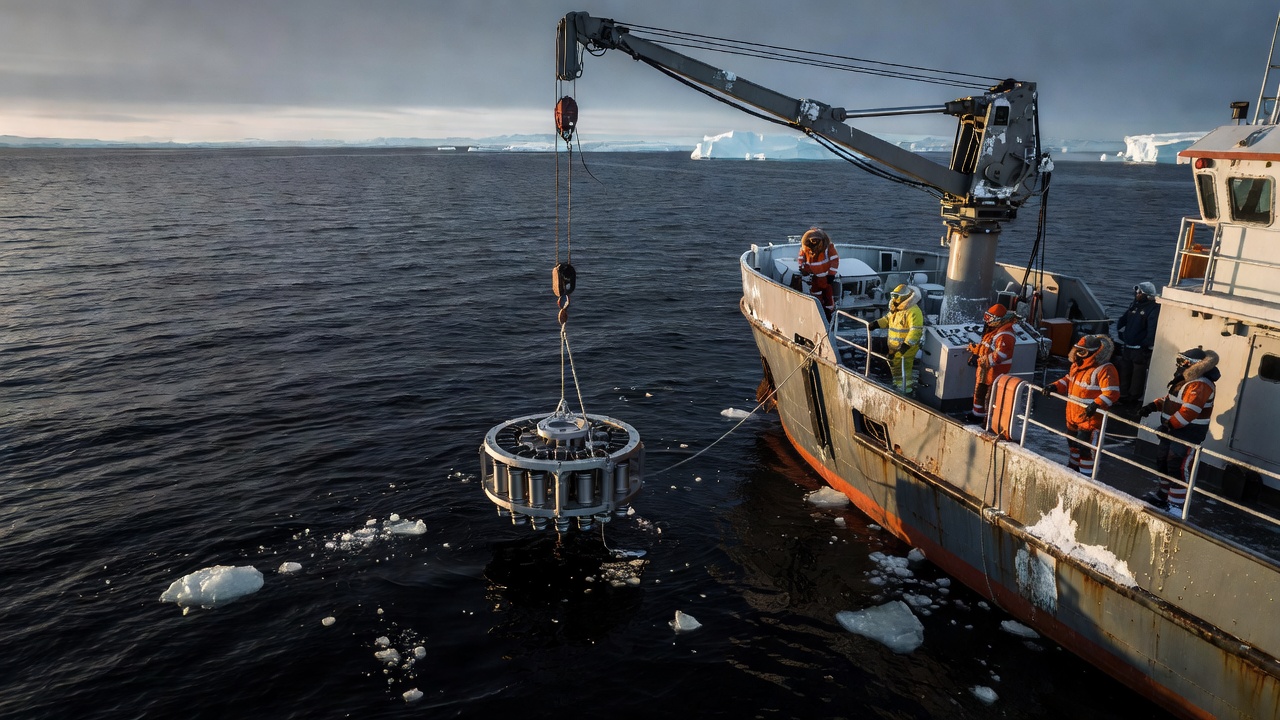
Instruments translate physical conditions into recorded signals. A conductivity, temperature and depth package, often called a CTD, profiles ocean conditions. Conductivity helps estimate salinity, while pressure helps establish depth. Water samples collected nearby can provide independent checks or measurements of nutrients, dissolved gases and other properties.
Calibration compares an instrument with a suitable reference. Researchers also check for drift, fouling, timing errors and unexpected values. A sensor may be precise—producing similar readings repeatedly—without being accurate if it has a systematic offset. Quality control aims to identify these problems before the data support a larger interpretation.
Metadata explain the circumstances of a measurement: position, time, instrument configuration, units and processing steps. Without that context, even a large collection of numbers can be difficult to reuse. Recording what was changed or excluded is part of the scientific result, not an administrative extra.
Polar fieldwork is shaped by access
Sea ice, storms, darkness and remote logistics limit where teams can work. Ships may need to change route. Instruments can be lost, batteries can fail and wildlife considerations can restrict activity. Autonomous buoys, moorings and satellites extend coverage, but each brings its own limits in resolution, durability and what it can observe.
The MOSAiC expedition, led by the Alfred Wegener Institute, used a drifting research platform to study the central Arctic across the annual cycle. Ny-Ålesund in Svalbard supports sustained observations in a different setting. Neither approach makes every part of the Arctic equally observed. Their value lies partly in how their measurements complement other records.
Fieldwork also involves permissions, environmental responsibilities and relationships with local communities. Appropriate collaboration begins before data collection, especially where research concerns Indigenous lands, knowledge or livelihoods. Access to a place is not the same as permission to use every kind of information associated with it.
From a pattern to an explanation
Analysis may compare seasons, estimate a trend or test whether two variables change together. A correlation can suggest a connection without establishing its cause. Researchers examine plausible mechanisms, competing explanations and whether the pattern persists under different analytical choices. Independent measurements can help separate a real signal from a processing artifact.
Models make assumptions explicit and allow researchers to test processes or explore possible futures. A projection conditional on emissions is not the same as an unconditional forecast. Agreement between a model and observations is useful, but the strength of that test depends on which variables, places and time periods were compared.
Measurement uncertainty
How well does the instrument or sampling procedure estimate the quantity of interest?
Interpretive uncertainty
How strongly do the available observations distinguish one explanation or future outcome from another?
What scrutiny adds
Peer review asks other specialists to examine a study’s methods, reasoning and presentation before publication. It can identify weaknesses and improve clarity, but it is not a guarantee that a conclusion will never change. Replication, new observations and subsequent debate remain important after a paper appears.
Confidence grows when different methods point toward the same explanation. An assessment such as an IPCC report evaluates a broader body of research rather than relying on one expedition. Its language about confidence and likelihood has defined meanings. Read those definitions instead of treating every qualified statement as hesitation or every strong statement as absolute certainty.
A five-part claim check
- Locate the original source. Find the paper, dataset or assessment behind the summary.
- Name the measured variable. Distinguish temperature, ice extent, mass, abundance and other quantities.
- Match the scope. Check the place, season, sampling period and comparison baseline.
- Find the limits. Look for uncertainty, missing coverage and assumptions that matter to the result.
- Compare the wording. Ask whether the headline is stronger or broader than the study’s own conclusion.
You do not need to reproduce every calculation to become a more careful reader. Knowing which question to ask next is already useful progress. When a claim remains unclear, a specific question about the method is usually more productive than a general argument about whether science can be trusted.
- MOSAiC expedition — year-round central Arctic research context.
- Alfred Wegener Institute — polar and marine research.
- Intergovernmental Panel on Climate Change — assessments of published climate evidence.
- PANGAEA — archived Earth and environmental science data.