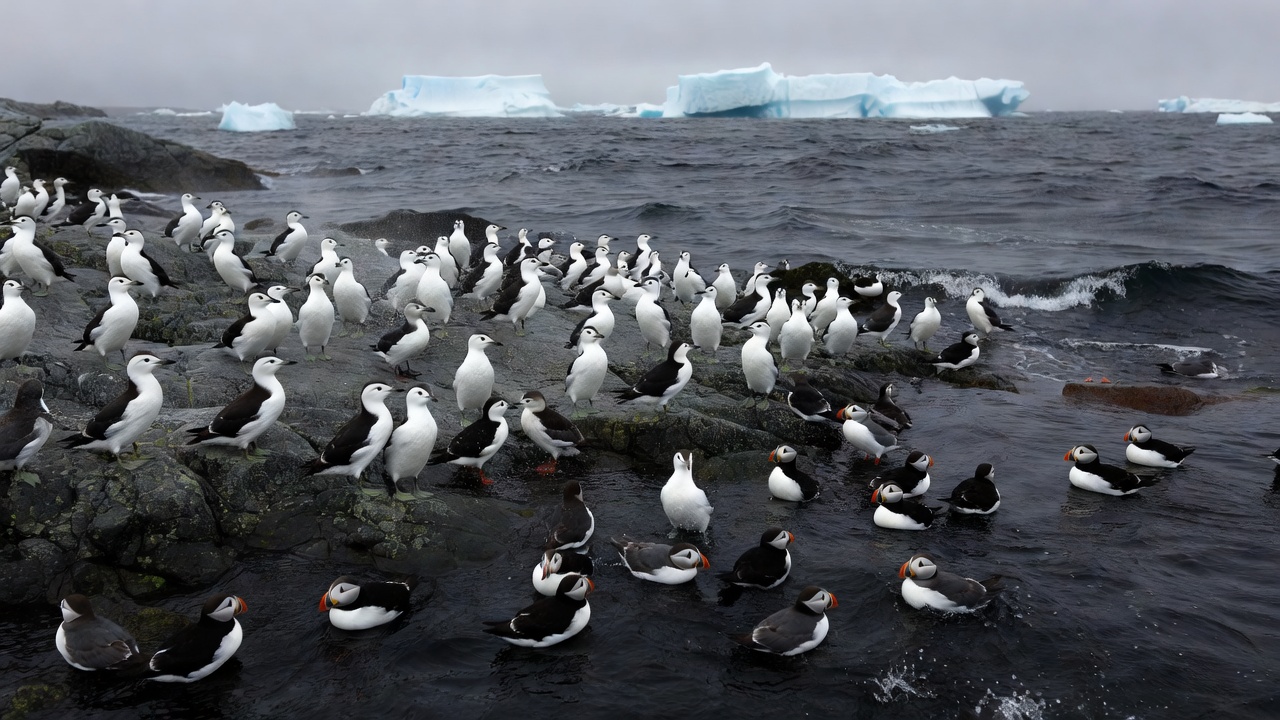
Begin with the seasonal food web
Arctic ecosystems depend on strong seasonal changes in light, ice and access to food. Ice algae can grow within or beneath sea ice when conditions allow. Phytoplankton bloom in the water, supporting zooplankton and the fish, seabirds and marine mammals that feed through connected pathways. These links vary across shelves, deep basins and coastal waters.
The timing of a food pulse can be as important as its size. If prey becomes abundant before a predator’s young need it most, the overlap may change. Such a mismatch is a hypothesis to test, not a conclusion to assume. Researchers need observations of both the food supply and the animals’ actual feeding or breeding schedule.
Sea ice is habitat, not empty space
Polar bears use sea ice as a platform for hunting seals. Ringed seals use snow-covered ice for resting and breeding structures. Walruses may rest on ice near feeding areas, although behavior and habitat use differ among populations and seasons. Changing ice conditions can alter travel distances, energy expenditure and access to prey.
These relationships are not identical for every species. Bowhead whales and many seabirds also depend on open-water features, while terrestrial animals face changes in snow, vegetation and rain-on-snow events. A single phrase such as “less ice” hides several ecological mechanisms. Effective explanations identify the pathway connecting environmental change to an observed biological response.
How researchers estimate abundance
Counting wildlife is difficult when animals move, dive, hide or occupy remote habitat. An aerial survey records the animals observers detect along a defined route. Statistical methods then account, where possible, for animals that were present but missed. Survey design and detection probability are central to the result, not minor technical footnotes.
Mark–recapture methods use repeat encounters with identifiable individuals to estimate population properties. Identification may involve tags, natural markings or genetic samples, depending on the species and study. These methods rest on assumptions about movement, detection and the sampled population. A published estimate should explain how uncertainty and possible bias were handled.
Observation
A survey records fewer animals along a route than during a previous visit.
Explanation
Possible causes include lower abundance, redistribution, changed visibility or different timing. Comparable methods help distinguish them.
Movement is evidence, with limits
Satellite tags and other tracking devices reveal where sampled animals travel. Combined with habitat maps, those tracks can identify migration corridors, feeding areas and seasonal exposure to human activity. They can also show behavior that would be hard to observe from a ship or shore.
A tracked sample may not represent every age group, sex or part of a population. Devices have operating limits, and deploying them requires ethical review and appropriate permits. Responsible interpretation asks which animals were sampled and whether their behavior can reasonably support a broader conclusion. More location points do not automatically mean a more representative study.
Conservation has more than one pressure to consider
Climate-related habitat change can interact with shipping, contaminants, fishing, industrial activity and disturbance. Some pollutants accumulate through food webs. Underwater noise can affect how marine mammals communicate or use habitat. Local pressures may be manageable even where a global driver requires wider action.
Protected areas are one tool, but a boundary alone does not guarantee a healthy ecosystem. Management must consider migration, enforcement, seasonal use and activities outside the protected area. Monitoring should test whether the intended outcome is occurring, rather than treating designation as proof of success.
Arctic Indigenous Peoples hold long-standing, place-based knowledge of animals, weather and sea ice. Respectful collaboration involves governance, consent, attribution and appropriate control over sensitive information. Indigenous knowledge is not simply a set of observations to extract and detach from its communities. Conservation decisions also affect rights, livelihoods and food security.
What a careful reader can do
For any wildlife claim, identify the species, population, place and time interval. Look for the sample size, survey method and uncertainty range. Separate a proposed mechanism from a demonstrated population effect. When comparing assessments, check whether both use the same geographic boundaries and conservation criteria.
For practical conservation, avoid disturbing animals to obtain photographs, follow local guidance and support monitoring that reports its methods. Never approach wildlife based on a generalized distance recommendation from an explanatory website. Local rules and qualified guidance take priority, especially around polar bears and breeding colonies.
- Conservation of Arctic Flora and Fauna — Arctic biodiversity assessments and monitoring.
- IUCN Red List — species assessments with criteria and supporting documentation.
- Polar Bears International — polar bear research and conservation explanations.
- Arctic Council — regional cooperation and the role of Indigenous Permanent Participants.